

The Lost Years
How I Fell into Relationship with Jesus Christ (And Wrote a Gnostic Screenplay About His Lost Years)

I never expected to fall into relationship with the likes of Jesus Christ. Three years ago, around the Imbolc of 2023, it would have been utterly unfathomable for the avowed Animist and Heretic that I was to become fascinated with that singular and enigmatic persona, and to go on to pen a tale of Our Lord and Savior’s Gnostic journey during the lost years of His life. Yet somehow, that’s exactly what happened.
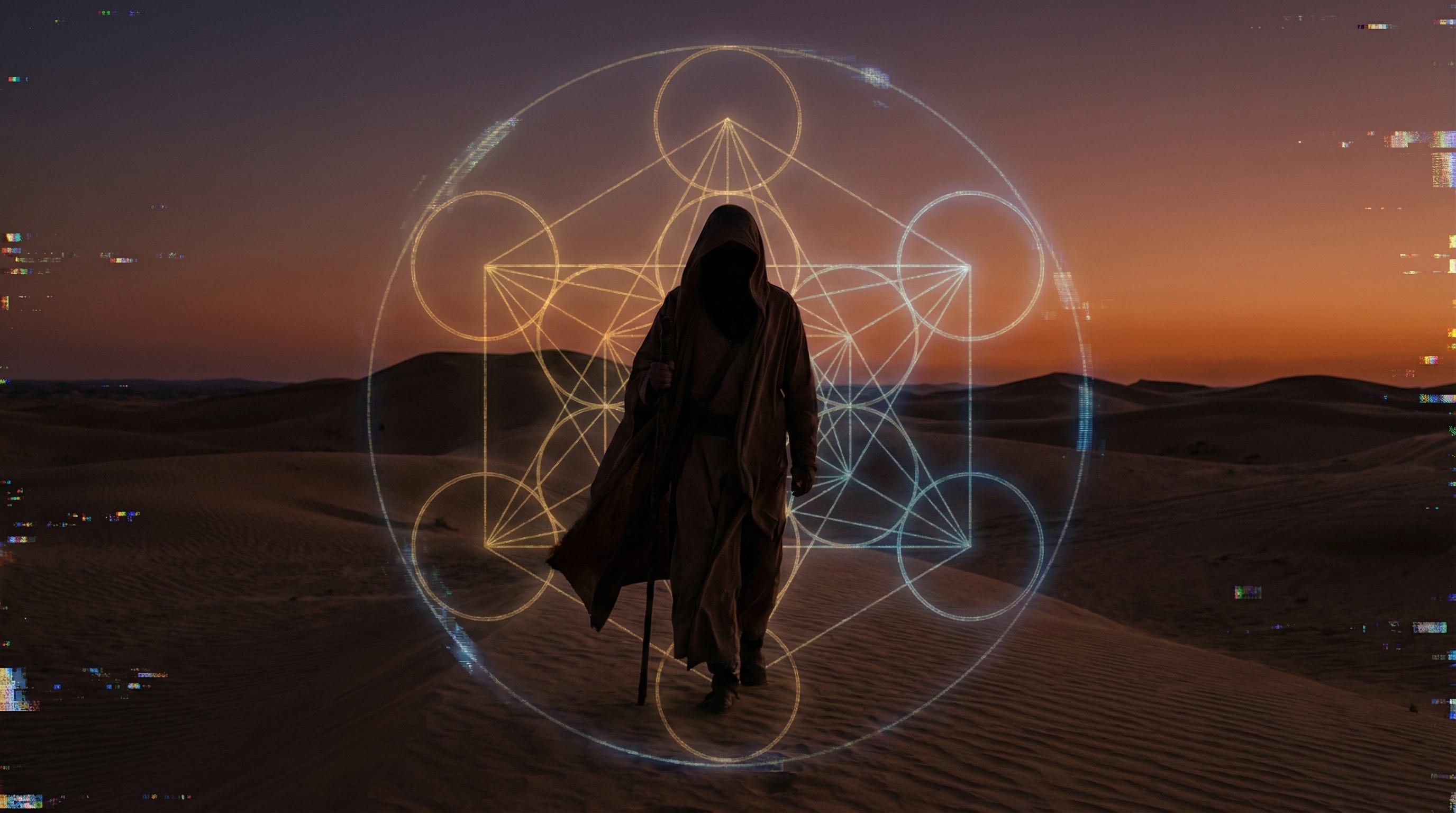
It began with a ritual. As any potent alchemical process does.
The notion occurred to me that I might like to be baptized into the San Francisco Bay. Not as a rite of religious conversion, or as a show of faith in some calcified doctrine. I envisioned that this baptism might seal my commitment to the living waters of Strawberry Creek, Tilden Regional and the Hills of Berkeley; it might affirm the vital relationships I had nourished through my men’s group — The Brethren, my daughter’s cooperative pre-school, and the Bay Area Healers’ Collective I had helped nurture into flourishing community. No more hiding. No more planning my escape to some remote eco-village that might survive the unraveling calamity of this turbulent age. That ritual submersion into the salty water would be how I proclaimed to myself: These are my people and this is where I make my stand.
But if I was going to go through with this, I needed someone to do the baptizing. Someone familiar with that particular ritual.
I called up one of my closest friends, Abel.
Abel and I had both come of age in the same high control religion, and over the years we supported and guided each other out of that insular community. We were groomsmen at each others’ weddings. He was my brother when all ties to my family of origin had been fractured. Abel initiated me into psychedelic exploration. He is a soulful, intelligent, sensitive, and deeply compassionate person. And while I evolved from the church into an unrepentant Pagan, Abel went on to divinity school and became a chaplain and Christian pastor.
When I described the ritual I had in mind, Abel responded, “Normally getting baptized means accepting Jesus Christ as your personal Lord and Savior.”
Pardon my language, but my immediate thought was, “Fuck that!”
I never jibed with the whole “Only Begotten Son… He died for your sins, so you can get a free pass to Heaven,” creed. So murderers and pedophiles can keep right on murdering and pedophiling as long as they claim at the end of the day: “Jesus Christ is my Lord and Savior?” Doesn’t that rob humans of their agency and the responsibility to do their own inner work, to transmute their wayward souls into Divine Essence?
Yeah… I was a Gnostic, before I even knew the word.
And yet, in the vehemence of my reaction to Abel’s suggestion, I sensed my Shadow at work. So when he invited me into Bible study, I obliged.
I’ll have to be honest: I wasn’t terribly impressed with the stories portrayed in the canonical gospels. My group-think radar pings at the slightest notion of cultish thought control. Matthew, Mark, Luke, and John were obviously each written to convert and convince particular groups of people about particular ideologies. I smelled their antiquated propaganda from a mile away.
But I could relate to the guy who spouted parables no one could understand — ancient koans carefully calibrated to shatter the small self into Infiniti. I could groove with the desert mystic who railed against Capitalism, flipping tables and driving the money-changers out of the temple.
And there were idiosyncrasies. Hints of an ontology far stranger than the monotheistic flatland I was being sold.
When Jesus healed the sick, I sat up.
When Jesus cast out demons, I noticed.
And when he performed miracles, I thought: What if…?
If you’ve ever sat for someone during a psychedelic journey, or experienced your own healing through altered states of consciousness, then you’ll know: there’s a lot of grunting and gurgling, yelping and shrieking and maniacal laughter, writhing on the ground and shaking uncontrollably. The uninitiated observer might think they’re watching an exorcism. Maybe it’s trauma being liberated from the bodymind matrix, or maybe we really are casting out demons. Who’s to say whether ancient- or modern-minded people properly grok such phenomena. Maybe it’s both.
Having presided over such miraculous healings and experienced numerous of my own, I thought I had an inkling about what Jesus might actually be doing. Hell, I’d even fasted in the desert like he had. I wanted to dig beneath the tired dogma and sanctioned interpretations to find out what this so called God-Man was really about. Needless to say, the King James Bible quickly proved insufficient to satisfy my curiosity.
Though there was one line that stood out to me:
After he was 12, “Jesus advanced in wisdom and stature, and in favor with God and men.” — Luke 2:52
And after that? Matthew, Mark, Luke, and John all pick up 18 years later.
Oh, come on!!! What??? Very convenient for them to cut out right as Young Jeezy hit puberty. What about his acne, his first crush and his first heartbreak? What about the rough road of young adulthood, as Jesus stumbled to find his place in the world and figure himself out? Some shit must have gone down during those “lost years” of Our Lord and Savior’s life that they really don’t want you to know about. What happened to his Hero’s Journey?
My curiosity ignited into an inferno.
I probed around in Rudolf Steiner’s esoteric cosmology, where the supernatural beings Lucifer and Ahriman — spiritual ascension and material descent — loom on either ends of human history, and the Christ balances them out in the middle.
I explored Dolores Cannon’s work on past-life regression, and learned that Jesus may have been an exceptional pupil in a reclusive community of Essene mystics, alongside his cousin, a young and rough John the Baptist.
There were records of Jesus studying in the temples of India and the Library of Alexandria. Folk-tales and myths proclaiming that he ventured to Japan, and as far as the Americas. I even stumbled upon convincing evidence that he brewed psychedelic wine, and that his original communion involved magic mushrooms.
This guy was a legend.
And that’s when I discovered the Gnostic Gospels.
Oh, those early church fathers tried real hard to stamp out such blasphemous drivel. They crucified Gnostics, burned their sacred manuscripts, and razed their mystery schools and temples to the ground. For over a thousand years, all that was known about the Gnostics was the slander written against them by the early Christians who called them heretics and hunted them down. Gnosis — to know thyself — was a crime punishable by death.
But in December 1945, a couple of farmers found a sealed urn in the desert of Egypt. Inside was a treasure trove of heresy: Gnostic manuscripts with names like The Hypostasis of the Archons, The Apocryphon of John, and Trimorphic Protennoia. And before academic gatekeepers could lock them away into secret archives, the texts were translated and unleashed into the world.
To me they read like ancient sci-fi, and I totally dig it. They tell of extra-dimensional entities known as The Archons, who live beneath the surface of perceived reality and manipulate human thoughts and emotions to keep us trapped in this prison of matter; think Agent Smith from The Matrix. The Gnostic Gospels point toward the innate divinity of each human soul, and our cosmic quest to realize the fullness of being. They tell of Sophia, the divine feminine wisdom whose creative impulse birthed the material world, and whose fall from the ideal realm of the Pleroma accidentally gave rise to the Demiurge. The Gnostic Gospels further suggest that the One True God of monotheism — Yahweh — is actually this Demiurge in disguise: an entity known as Yaldabaoth, the false architect of our prison and lord of the Archons, born from Sophia’s shadow.
Heresy of heresies: God is actually the Devil.
Yet decidedly more hateful to the church fathers than that preposterous accusation: Jesus was one of the chief Gnostic Revealers. Like Neo, situated in the center of humanity’s struggle against the Archons, Jesus came to awaken the sleepwalkers from the matrix of this shadow world.
Now that’s a cosmic drama I’d love to play in.
So that’s what I did.
The idea came to me after reading a splendidly bonkers and delightfully imaginative book by Bob Frissell called Nothing in this Book is True, But it’s Exactly How Things Are. It’s got everything from lost civilizations on Mars to gray aliens and psychic training. But what I found particularly fascinating was Mr. Frissell’s exploration of ancient Egyptian mystery schools and their esoteric initiations in the hidden chambers of the pyramids. And I thought…
What if Jesus plus pyramids?
It would be a globe-spanning epic of Yeshua’s journey during the lost years of his life, as he and John the Baptist steal forbidden scrolls from Egyptian mystery schools, unlock reality-bending powers within the pyramids, and join the rebellion against an empire — both Roman and cosmic — that seeks to enslave humanity’s divine spark.
At first I thought it would be a feature film, but the world and the characters and their epic struggle grew beyond anything I could reasonably wrangle into 90-120 pages of script. Beyond the pyramids, Yeshua’s journey could go on for several seasons, exploring far-flung cosmologies and empires of all kinds, mystery schools and secret initiations across the world, as he delved deeper into his divine nature and ignited a wave of gnostic awakening in his wake.
But I was far from the seasoned showrunner who could manage that kind of epic tale. I needed training. I needed my own initiation.
So I took screenwriting and filmmaking courses. I was mentored and ghosted and kicked out of my writing group for coming up with such dissidence. I submitted to competitions and professional feedback services. Draft after draft after draft, I worked this thing over 30 or more iterations.
I don’t know why I didn’t give up.
Well, actually, I did give up. Many times.
I’d take the feedback, digest it. After a period of desolation, finally I could understand what I was missing, what the story really needed. A new vision would arrive, of how everything lined up, new scenes and sequences, lines of dialogue that felt truer to each character, a deeper understanding of the thematic core of the story. Then the creative fire would roar to life again, and I blazed through another draft.
Version 5…
Version 8…
Version 12…
One of my early mentors taught me that the script gets exponentially better with every re-write. And it was true. I’d never written anything like this before. So potent and dangerous. I wrote a pair of Roman legionnaires with Key and Peele’s comedic energy, pursuing Yeshua and Yochan across the desert. Yochan, a young John the Baptist, getting into a tavern brawl defending his troublesome cousin. Mary Magdalene wielding psychedelic kung-fu, healing and awakening with her touch like Evelyn from Everything, Everywhere, All at Once. Yesh losing control, overwhelmed by the violence of the world around him, and summoning a flock of ravens that tear through the town. The world began to live and breathe with cinematic moments dying to be filmed. The dull edges began to glitter like gold.
And still the feedback kept coming:
This is the wrong beat to end your pilot.
These characters belong in episode two or three.
What does Yeshua really want? And what does he need?
Version 14…
Version 17…
Version 20…
I was smashed and battered, devastated and defeated. Every time I thought I finally had it, another round of feedback pointed out something painfully true and hard to hear. My frail ego popped like a balloon, and I lay deflated for weeks or months at a time.
But I wasn’t doing nothing. I was processing, integrating. Even when I wasn’t actively thinking about The Lost Years, my subconscious was working on overdrive, populating my dreams and guiding my waking interests. I listened on repeat to screencraft books and podcasts. I binged through Whitley Strieber’s corpus of high strangeness, Jacques Valee’s accounts of anomalous experience, and DW Pasulka’s anthropological excavations into the uncanny occurrences in our own watered down history. I sat under the stars at night and opened myself to the question: Could this world be more miraculous than I can possibly fathom?
Somewhere along the way — I can’t pinpoint exactly when — the question shifted.
I wasn’t just asking: What does Yeshua the character want? What does this story need?
I was asking: Who the fuck really was this guy?
Not the sanitized Sunday School version. Not the theological construct. The person. The one who healed and exorcised and performed miracles. The one who grew up in occupied territory under Roman boot, navigating the corrupted religion of his fathers, and trying to make sense of gifts he couldn’t understand.
And the deeper I plumbed into Yeshua’s character and core wounds, his darkest yearnings and highest aspirations, the more I had to excavate within myself.
Who was I to write the story of how a precocious young mischief-maker from Judea became the Christ? What hubris made me think I could understand that singular figure better than scholars, priests, and pastors?
I don’t know.
I don’t know.
I don’t know.
And yet The Lost Years wouldn’t let me go. Draft after draft, I dug deeper into Yeshua and deeper into my own preconceived notions about how the world works and what it means to be human.
A response came to me from an unlikely source — a story I dismissed as childish fantasy when I first read it in high school. ‘The Infancy Gospel of Thomas’ is a collection of anecdotes of Jesus as a boy, which aren’t recorded in the canonical gospels. And for good reason. The Infancy Gospel portrays young Jesus getting messy, making mistakes, lashing out with his gifts in ways that hurt and even kill — a child learning to wield immense power he doesn’t yet understand how to control. But the very first moment we meet Jesus, he’s five years old, kneeling beside a muddy puddle at the edge of a Judean creek with children crowded around. Young Jesus shapes the cold mud in his hands; and then, with a word, animates it into a living, breathing bird.
Having been thoroughly indoctrinated through western education, I couldn’t believe it. When I started shaping The Lost Years, I might have believed the healings were real. But the miracles? Those had to be metaphors, right? Safe. Explainable. People don’t walk on water. No human can calm the storms or raise the dead or turn mud into birds.
But that image called back to me from across the years.
Maybe it wasn’t just a metaphor.
Maybe reality is far more malleable than I had been led to believe.
And as I wrote Yeshua reaching into the imaginal realm and re-shaping the world according to his will, I couldn’t avoid the implications anymore.
What if this whole physical existence emerges from consciousness? Then miracles aren’t violations of natural law — they’re a remembering of how to attune directly with the source from which everything arises.
I was having my own anomalous encounters by then. Out-of-body journeys and psychedelic experiences that felt more real than waking life. Encounters at 3 AM with presences, beings that resonated through my whole body. Energy moving through me in ways that defied explanation. When I sat on my roof at night and gazed up at the stars, occasionally something would wink back.
And I realized: the Gnostics weren’t writing theology. They were writing experience reports. Maps of territories they’d actually traveled.
And Yeshua? He was one of them.
Not a savior. Not the Only Begotten Son.
A fellow psychonaut. An ancient traveler who’d walked a parallel path to the one I was stumbling down — rebelling against empire, breaking free from systems of thought control, and encountering the mechanisms of reality manipulation. Like me, Jesus was having experiences and developing abilities he couldn’t explain; he got rejected for speaking what he’d seen. And yet he kept going anyway, just like I had.
A companion across 2000 years.
Version 23…
Version 27…
If I was going to continue channeling this story into the world, I needed another ritual.
I pulled all my notebooks out of their drawers, all the notecards I had hidden away in boxes, and dumped them together into a big pile in the middle of my office. The Lost Years had explored itself through twenty or more paperback notebooks, hundreds of multi-colored notecards filled with my inscrutable handwriting. It was a big pile. It was a lot to hold.
So I shoved it all into a backpack, and hiked up into the Berkeley hills, weaving my way toward the source of Strawberry Creek. I found my sacred spot in the Hidden Redwood Grove. Wanted to make a ritual fire, but that’s a no-go in the California Summers. I dug a hole instead. Opened my backpack and dumped all those notecards and notebooks into the Earth. I covered them with dirt and laid my hands upon the moist soil. And I prayed:
“May all my effort be an offering for the healing and regeneration of our planet. May soul-aligned mentors and collaborators manifest, to help steward The Lost Years into the world. May this story revitalize Gnostic wisdom and initiate awakening for those who have the ears to hear. And may it help guide us through the paradigm shift we need, in order to meet this troubled moment and evolve.”
I rose to my feet, tears in my eyes, brimming with gratitude for the remarkable journey that The Lost Years had guided me through. A true alchemical process.
Then I threw in one last request:
“And if there’s anyone out there… Aliens. Higher Dimensional Beings. Gods, Goddesses, or Angels… Anyone at all who might like to make contact with me, I’m ready. Bring it on.”
That night, in the liminal space between waking and sleep, I jolted awake with the sudden impression that someone or something was coming through my front door.
I made sure it was locked. Said a prayer of protection. Went back to sleep.
Next night, something tried to get in through the sky-light in my kitchen, closer to where I sleep in the office.
And on the third night, I came screaming out of the liminal dream-space, convinced that something was coming through the office window, right beside me. My wife found me there, hand pressed against the glass, and gazing out with a ghostly look on my face.
I told her about my ritual, and the invitation I had made. And she chided me, “Don’t go inviting unknown entities into our apartment. We’ve got young children here!”
She was right. In my urgency to know the mysteries, I had unwittingly imperiled the already chaotic harmony of parenting a toddler and a kindergartner while keeping up with the laundry and the dishes.
I needed better boundaries.
My prayer then became: I want to deepen in gnosis. I want to participate in Greater Reality. I want to make communion with benevolent beings when the time is right for me and my family, and in a way that is safe.
But for nights afterward, maybe weeks, I’d rise to relieve myself in the restroom. And when I passed through the kitchen, my body went into alarm. Goosebumps prickling across my flesh. Hairs standing on end. Something was there. A presence I couldn’t see, but could certainly feel.
Or imagined I was feeling.
Was something really there? Or was my thinking that something could be there enough to stimulate such a severe physiological reaction?
Or maybe it could be both.
Maybe believing in something enough can actually manifest it into reality.
Whatever the case, I was terrified. Thoroughly unsettled. But rather than turn away from the discomfort and try to sleep, I went to my meditation cushion and sat with it. Holding presence for the sensations arising in my body, while I felt as if something was watching me from the kitchen. Feeling my way through the ontological shock of realizing that this universe really could be way weirder than my wildest fantasies.
Version 30 of The Lost Years is the coolest fucking thing I’ve ever written. And I’ll keep drafting until the story is undeniable. But it won’t be finished until it’s filmed. It needs a whole team of awakening souls, Gnostics and Heretics, Pagans and Animists and Cultural Revolutionaries, to help me hold it, to help me steward it into the world.
I finally told my mom about the presence I’d felt in the kitchen, and she shared that she had sensed something there too.
When it’s time for my son’s nap, grandma cozies him up on her chest and soothes him in the rocking chair that faces the spot in question. And one day, as my little boy drifted to sleep, my mom began to nod off too.
But then she jolted awake, out of the liminal dream-space, with the sudden impression that someone was standing in that very spot in the kitchen. Someone was looking toward the closed door of my office, watching while I was focused on another draft.
And you know who my mom said she saw?
Jesus. Fucking. Christ.
Okay, I’ll give it to him. Yeshua can be my Lord and Savior if he wants it that badly.
Not the Lord and Savior of dogma and empire. The troublemaker. The psychonaut. The one who still shows up in kitchens at 3 AM, waiting to see who’s ready to let him in.
So here it is — what three years of alchemical fire produced:
A pilot screenplay called THE LOST YEARS
The 18 years the Bible won’t tell you about.
Yeshua and his cousin Yochan steal scrolls from Egyptian mystery schools, unlock reality-bending abilities, and discover humanity’s divine spark is being suppressed by forces both Roman and cosmic.
Indiana Jones meets X-Men meets The Matrix — in 25 AD.
I’ve built a proof-of-concept trailer using AI filmmaking tools. It was messy, experimental, and a whole lot of fun. And now it’s LIVE!
You can continue to follow this journey through my Instagram @jm.swen or through my YouTube channel @JoshuaMSwenson
Pilot script available upon request: TheLostYears.tv@gmail.com
I love this and am excited to read more!!!
Excited for the teaser and to read more about the process.
Also this Abel guy sounds like a real piece of work